
A New Mindset
Designing spaces to create a cognitive advantage
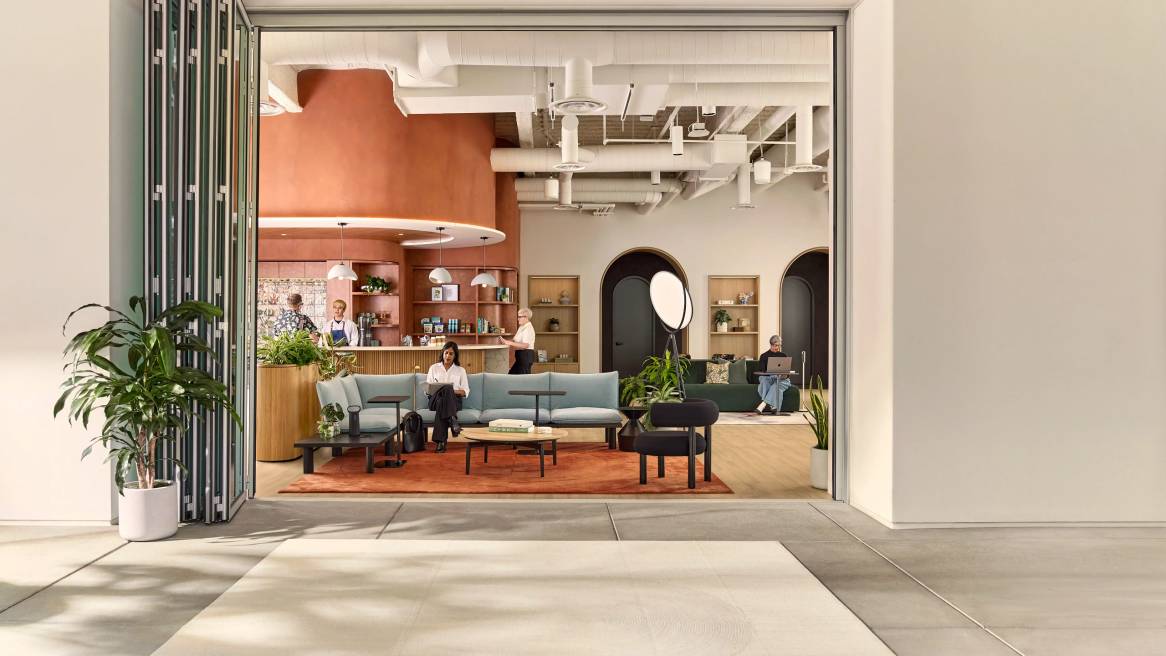
Every morning, we bring our distinct human potential to work. It is the engine of our creativity, our resilience and our ability to connect with others. But too often, we treat the mind like software. We expect it to be limitless and always ready to run. The reality is the human mind is a biological organ. It tires and reacts to its surroundings, to noise and visual chaos, just as our lungs react to air quality.
We’re attempting to do 21st-century work — AI-enabled, fast, synthetic — with a brain built for survival. But AI can’t replace the human mind’s capacity to solve problems and create new ideas. We need a new mindset, focused on helping people think better in the age of AI.
We are now operating in the “brain economy,” which, according to a recent report released at The World Economic Forum with the McKinsey Health Institute, “represents a new frontier where human intelligence and artificial intelligence work in partnership, allowing for greater productivity and resilience.” The report advocates for building “brain capital,” which combines brain health — the functional ability of the brain to perform the many tasks it’s responsible for — and brain skills, such as the ability to think clearly, learn, manage attention, make decisions and solve problems. Basically, everything we do at work.
As neuroscientist Harris Eyre, lead of the Brain Capital Alliance, notes, this era demands a transition “from the current state of our economy, which is depleting brain capital, to a place where we are building brain capital.” There are many routes organizations can take to build brain capital, and one that is often overlooked is the built environment. The growing field of neuroarchitecture seeks to build brain health by researching the best ways to design physical spaces that help people mentally, emotionally and physically.
This raises the stakes for our workplaces. The office is no longer just a place to work – it must evolve into a cognitive support system.
Cognitive crisis
In the modern workplace, our experience can feel like animals in the wild. We are stuck in a state of hyper-vigilance, constantly scanning for information and threats (or Slack notifications). This reactive state makes deep, resonant thinking nearly impossible. Our brains can’t process all the information they’re flooded with each day, and screen-based technology increases the volume.
Our average attention span has declined from 2.5 minutes in 2004 to 47 seconds, according to research by Dr. Gloria Mark at UC Irvine. Smartphones accelerated the decline.
Our attention has become a precious resource and a form of biological fuel. Researchers distinguish between two types of focus, a concept explored in the Steelcase report Think Better: Neuroscience as a Competitive Advantage. “Controlled attention” is high-octane, expensive fuel used for deep work and strategy. It is finite and drains quickly. “Stimulus-driven attention” is cheap, reactive fuel used when a loud noise or a moving object grabs our focus. Poorly designed open offices force us into a permanent state of stimulus-driven attention. We burn precious energy filtering out distractions, leaving little fuel for actual work.
Additionally, the biological need for cognitive offloading is often overlooked. The brain cannot hold everything at once; we need physical environments to “hold” our thoughts for us. When you sketch on a whiteboard or pin to a wall, you offload working memory to the room, freeing your brain to process information rather than store it. A laptop screen cannot replicate this spatial canvas. It restricts our field of view, forcing us to scroll through isolated pieces of information rather than seeing them together. To untangle complex problems, the brain needs to see the whole picture at once to connect the dots effectively.
Sustained Attention Response Task Study
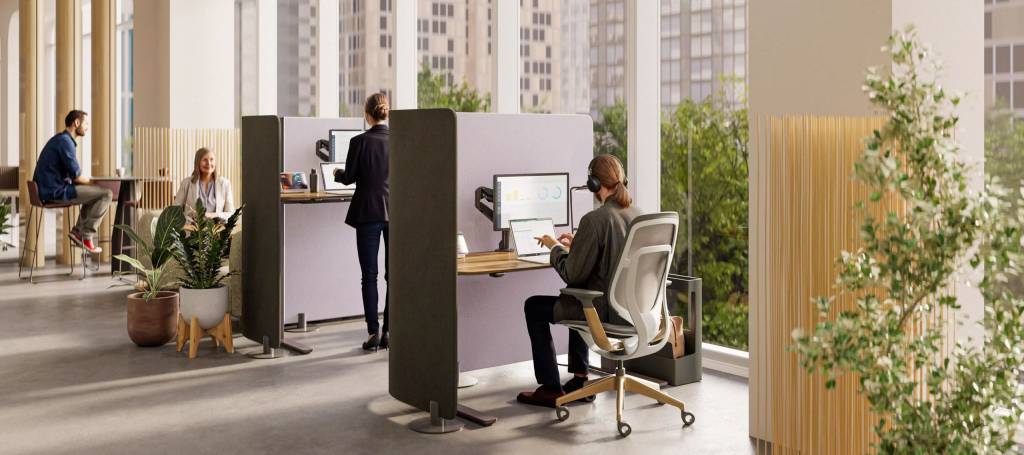
Steelcase research reveals a surprising result: visual privacy helps people manage distractions — even noise. The most common complaint in the office is distractions, especially in open-plan layouts where people often sit at benches. While intended to foster interactions and collaboration, too much openness can leave people overexposed and unable to focus. But Steelcase research, conducted in partnership with the Center for Healthy Minds at the University of Wisconsin, Madison, found an easy intervention to help people manage a range of distractions: visual privacy.
Researchers measured “sustained attention,” or the ability to focus on a task over time. Participants performed cognitive tasks in two different settings: a completely open bench and a semi-shielded individual workspace. Both environments played the same track of background office noise.
The results: Participants with visual privacy performed significantly better on tasks requiring sustained attention than those seated at an open workbench – even with identical noise levels. They committed significantly fewer errors and demonstrated superior focus compared to people working at a bench.
The insight: When we are exposed to visual stimulation, such as seeing people laughing or walking by, our brains burn energy trying to filter out the distraction. Our peripheral vision is especially sensitive to motion, which helps us detect threats, but also creates a distraction that our brains have to process. But screens, shelving units, or other privacy elements help reduce that cognitive load, essentially giving the brain the extra “bandwidth” it needs to filter out noise and allowing people to perform better at work that requires higher concentration levels.
From badge swipes to brain power
For decades, we have operated in the Attendance Era. Presence measured success. If your badge swiped in at 8:00 a.m. and out at 5:00 p.m., you were considered productive. In our new reality, AI automates routine tasks, and the premium asset is cognitive capacity — the uniquely human ability to navigate ambiguity and exercise critical judgment. We have entered the Attention Era, where brain health is no longer “just” a personal wellness goal but also a strategic business asset.
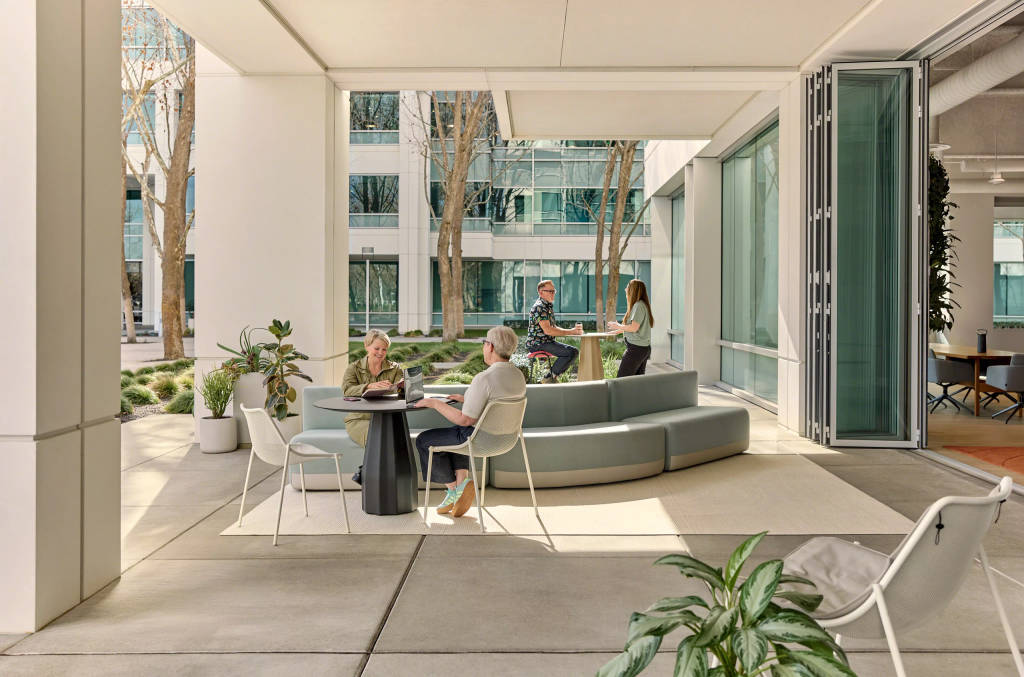
“In the Attendance Era, the office was a container for people. In the Attention Era, it must support concentration, collaboration and creativity. To solve complex problems today, we need environments that relieve the cognitive burden rather than add to it,” says WorkSpace Futures researcher Patricia Kammer.
Many leaders are still optimizing for attendance mandates (“Are you here?”) rather than enabling performance (“Can you think?”).
We are moving from an era defined by where you work to one defined by how you think.
Patricia KammerSteelcase WorkSpace Futures Researcher
Today’s Workplace: A New Operating Model
Here’s what changes when performance is defined by cognition, not occupancy.
| The Past: Attendance Era | The Present: Attention Era | |
| Primary Metric | Badge swipes + occupancy | Cognitive readiness + output quality |
| The Core Question | “Are you there?” | “Can you think?” |
| Value Driver | Accumulating knowledge | Synthesizing data + creating |
| Office Role | A container for staff | A generator of innovation |
| Management Style | Mandate + control | Autonomy + stewardship |
Ergonomics for the brain
In today’s brain economy, we need a new mindset about the role of design in our workplaces. We need to shift from thinking about reducing distractions to designing spaces that help people do their best thinking – solving complex problems, being creative and more resilient in the face of change.
For years, scientists believed the adult brain stopped growing. We now know that neurogenesis, or the growth of new neurons, and neuroplasticity, the brain’s ability to rewire or strengthen new connections (synapses), are possible throughout our lives. Designing sensory-rich environments, including our offices, can boost this process. “Research suggests that environmental enrichment (social, sensory, physical and cognitive stimuli) can create new synapses in the brain, changing the brain physiologically,” says Dr. Upali Nanda, global sector director of innovation at HKS and member of the Brain Capital Alliance. “Think of enriched environments as a direct and powerful pathway to brain health.”
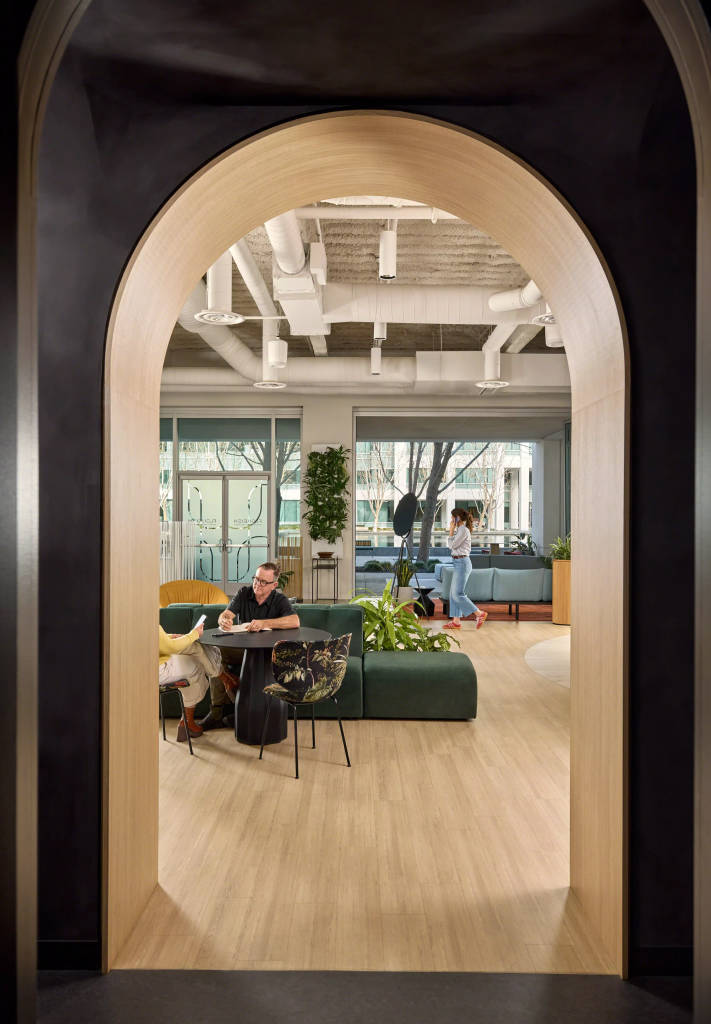
We readily accept that we need ergonomic chairs to support our spines. Today, designers can apply similar rigor to “cognitive ergonomics,” moving from simply supporting the body’s posture to understanding how the brain’s performance relates to its surroundings.
This isn’t about a single perfect room type. It’s about a variety of spaces specifically designed to support the types of work people do while supporting what the brain needs to function at its best.
Community-Based Design, the approach Steelcase uses for its own workplaces, offers a diverse range of “districts,” or zones, composed of spaces that give people greater choice and autonomy over how they work. This approach creates an infrastructure for building social connections that improves cognitive health and decreases cognitive decline. It provides places for people to better manage their attention and emotions. Ultimately, it helps people thrive and organizations to be more agile.
“Flexible workspaces are a prime example of how design can support brain health,” notes Dr. Debbie Beck, principal, at Perkins & Will and a key contributor to The Building Brains Coalition’s latest report. “These adaptable environments allow individuals to tailor their surroundings to fit their working styles and preferences, which can enhance focus and cognitive performance. By accommodating new technologies and work methodologies, flexible workspaces help keep the brain engaged and agile, promoting mental resilience and productivity,” she notes.
There is a range of spaces organizations can explore to better support the brain:
Spaces for connection
There’s no need to demonize the open floorplan, though. Open areas, such as cafe spaces, serve as a “city center” — a relaxed, alternative to individual desks and a place to make connections. It’s a place for shared energy and informal knowledge transfer. “Loneliness triggers a ‘threat state’ in the brain,” explains Patricia Kammer. “We cannot innovate if we feel socially isolated.” The office provides a “collective identity” that virtual meeting platforms cannot fully replicate. This is partly because face-to-face interaction releases neurochemicals essential to building trust and psychological safety, which are the foundations of risk-taking and innovation.
Spaces for rejuvenation
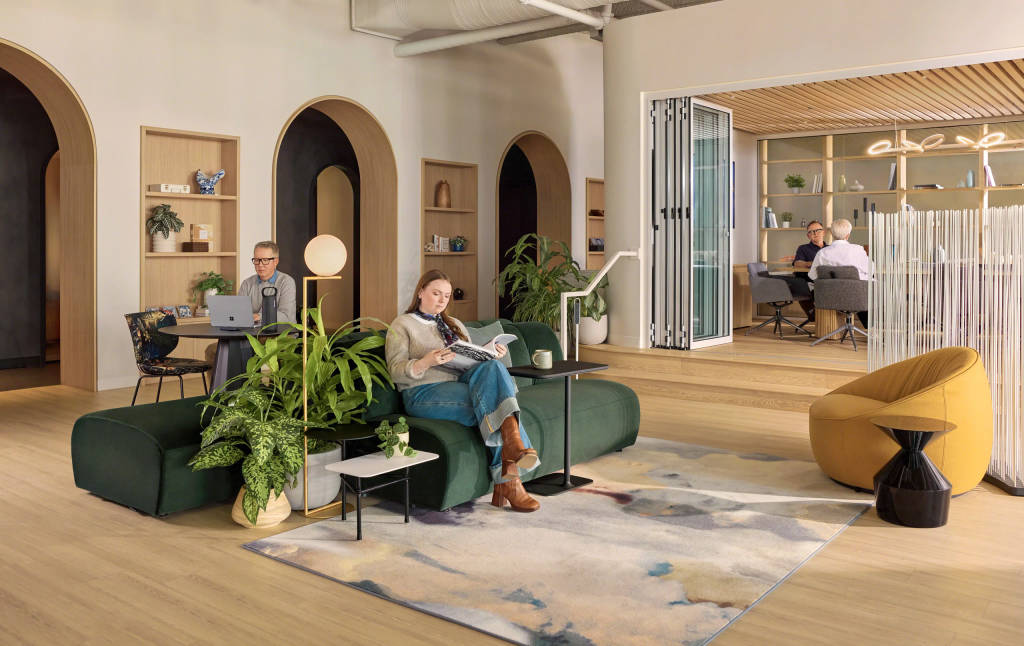
The brain cannot sprint for eight hours. It needs “palate cleansers” to replenish resources. The answer lies in our biology. Psychological studies show that “positive affect” (feelings of joy and comfort) increases dopamine levels, which in turn improves creative problem-solving.
NBBJ Fellow and molecular biologist Dr. John Medina reminds us that nature is a powerful trigger for positive affect. Specific cues tap into our biology: color palettes of blues, greens and oranges can aid focus, while rounded edges make us feel safer than sharp corners. Natural materials such as wood and wool are “organic” elements that help lower stress and reset cognitive capacity.
Spaces for movement
Bodily experiences and our physical surroundings influence cognition — including memory, emotion, and decision-making. Movement engages areas of the brain that help offload working
memory, freeing up energy for other areas to develop novel solutions to problems.
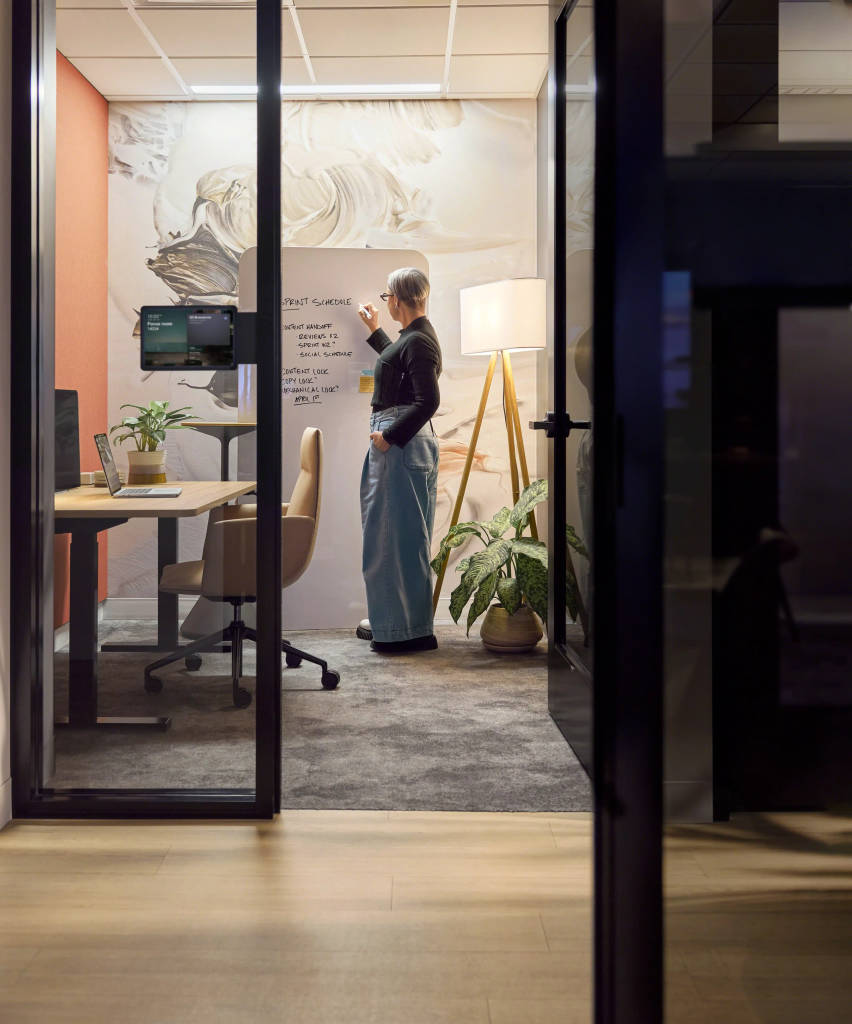
Spaces that promote movement and physically engaging in collaboration — standing, perching and reorienting — help circulate dopamine, which improves attention, creativity and problem-solving. Spaces equipped with whiteboards and vertical pin-up areas foster physical participation in group work sessions and also enable “cognitive offloading.” By making information persistent and visible, we free up working memory for processing rather than storage. The room itself becomes the external hard drive.
Spaces for focus
Deep work requires protection. “Inhibition control” is the biological energy required to stop impulsive actions and ignore distractions. When we are exposed to constant noise and visual stimulation, our brains subconsciously monitor the room. For open plans to work, they must be balanced with high-privacy spaces, such as pods or shielded workstations, that reduce distractions. Gaining focus doesn’t always require fully enclosed spaces.
The Leadership Pivot: From Efficiency to Capacity
Design is not the sole answer to brain health. But it is “an underleveraged intervention that can directly impact cognitive performance,” says Dr. Nanda. For leaders, this requires a shift in metrics.

We have spent decades measuring “operational efficiency” (how cheaply we can house employees). Now, the brain economy asks us to measure our “innovation capacity” (how effectively we can support their minds). We can’t slow the velocity of information. But we can design workplaces that protect attention, reduce cognitive load and empower us to perform at our highest potential. In the brain economy, the ultimate competitive advantage isn’t your real estate footprint. It is your people’s collective ability to think deeply and solve complex problems. “The brain health of your employees is the engine for your company’s productivity,” notes Eyre.