
The Faculty Office Moment of Truth
Design guidance for offices that work harder for faculty in a changing academic day.
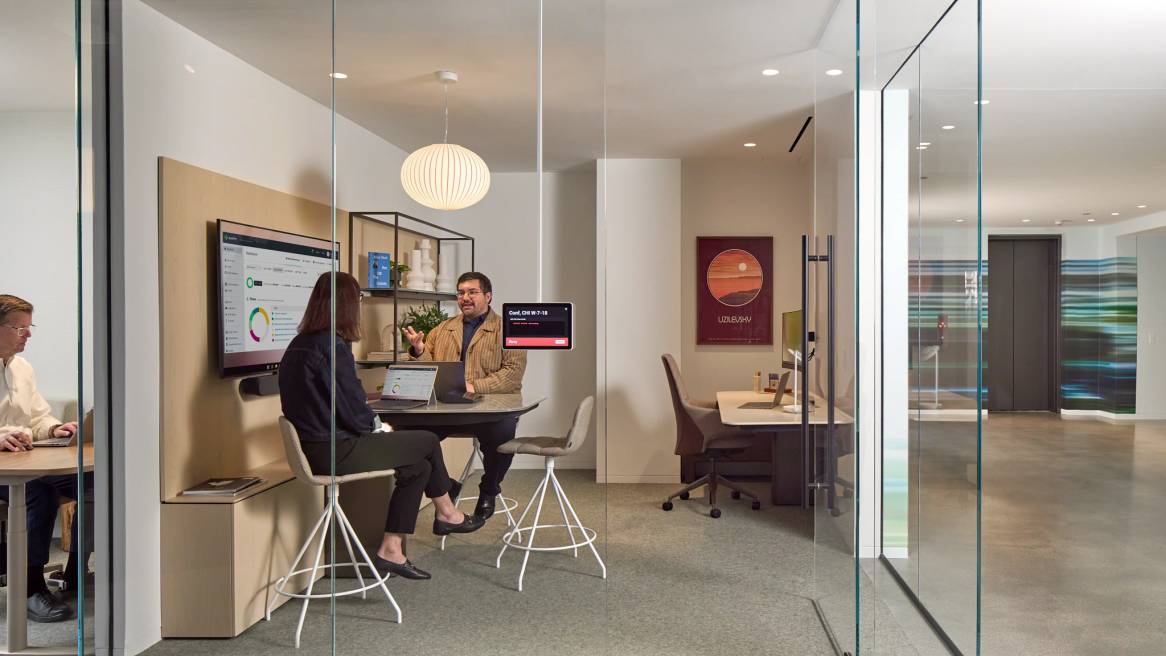
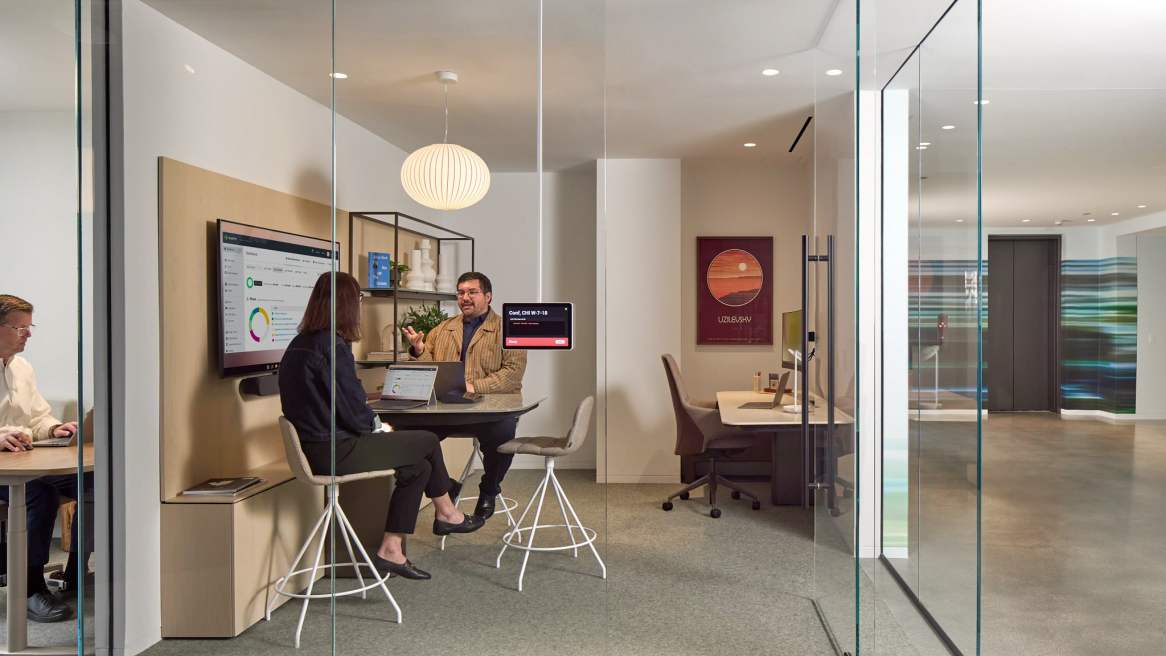
Picture a typical day for a faculty member.
A student stops by with a question that needs more than a quick answer. A committee meeting is scheduled to start in 10 minutes, with some participants on campus and others joining virtually. Later, there is a narrow window to focus, prepare for class, review research, write or think before the next conversation begins.
None of this is unusual. Faculty work has always carried multiple responsibilities. What is changing is the pace, the range of tasks, and the reality that teaching and collaboration often extend beyond one place or the traditional classroom.
Keeping students focused is another challenge: 2/3 of instructors say they struggle to keep students engaged, and 55% of undergraduates have difficulty participating in class, according to Wiley, a global research and education company. Students are coming with different expectations and mindsets, and hybrid instruction and virtual or remote connections have become integral to how many faculty engage with students and colleagues.
This creates a practical question for campus leaders, facilities teams and designers: Do faculty spaces support the full rhythm of faculty work today across modes, across moments and across the human needs that underpin performance?
Faculty work is changing. Many spaces have not kept up.
Steelcase Learning research identified several shifts affecting faculty work, including increasing instructional demands, advances in pedagogy, rising service expectations, and the growing complexity of hybrid instruction. Research also continues to evolve through cross-disciplinary collaboration, global networks and AI-enhanced tools that can accelerate inquiry.
Many institutions are already responding by rethinking how space is allocated and used in response to these shifts. There is also a measurable incentive. Data from client engagements with Steelcase’s Applied Research and Consulting team suggests potential real estate savings of 10% to 50% when spaces are aligned to faculty patterns.
Still, the strongest reason to change is a human one. When the environment is designed to support how people are working now, it becomes easier to sustain focus, strengthen connections with students and collaborate effectively in person and virtually.

The faculty office is more than a room
A common misconception is that improving faculty space is primarily about aesthetics or amenities. The research points to something more fundamental: a private office is more than a room. It can directly influence faculty performance and engagement.
Faculty offices often serve as a hub for deep thinking, preparation, mentoring and sensitive conversations. When cognitive and ergonomic needs are not supported, the cost shows up as friction. Seating, posture, lighting, acoustics or layout can work against people. It takes more effort to do work that already requires high concentration and emotional presence.
Because the office is also a student-facing environment, its impact extends beyond the faculty member who occupies it.
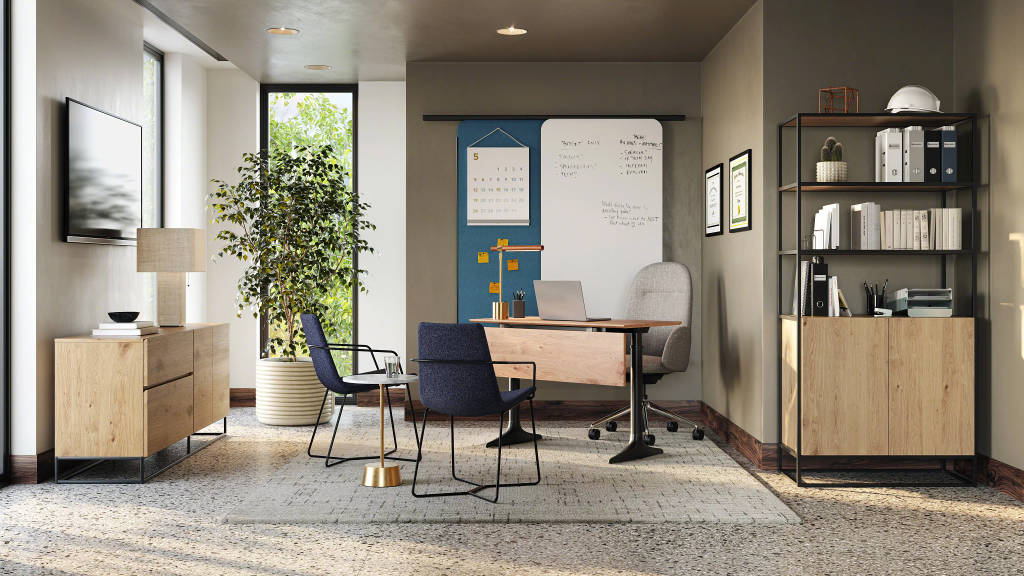
To better understand how the built environment can support faculty today, Steelcase Learning conducted human-centered research using multiple qualitative and quantitative methods.
Research methods included:
- Literature review
- Interviews and surveys
- Diary studies
- Observational research
- Space assessments
- Environmental prototypes
Five research findings that reveal where spaces fall short
The research revealed five key findings about how current spaces can limit faculty effectiveness:
- Offices are not meeting faculty’s cognitive and ergonomic needs.
- Collaboration spaces often do not support hybrid work or multiple interaction modes.
- Transition spaces are underutilized and do not support faculty and student needs.
- Faculty offices often feel unwelcoming to students.
- Many faculty environments lack spaces that support wellbeing.
Each finding, taken individually, points to a solvable problem. Together, they reveal a broader pattern. Faculty environments are often designed for a narrower view of faculty work than what the role now requires.
The hybrid reality: Collaboration needs to work for everyone.
Few issues make the gap between evolving faculty work and outdated collaboration spaces more visible than hybrid collaboration.
Faculty collaboration spans time, location and discipline. Yet many collaboration spaces were designed for a single mode where everyone is in the same room, facing the same way, sharing the same cues. Steelcase research found that 64% of users value hybrid collaboration spaces. At the same time, meeting spaces can create “presence disparities” that affect participation and connection.
The goal is not to make every meeting feel identical. The goal is to make participation more equitable across in-person and remote participants. Collaboration should support the work, not add strain to it.
Student voice: What faculty offices can communicate.
If the faculty office is a primary point of contact for advising, mentoring and relationship building, how students experience that space matters. In the research, students described faculty offices using words that should give leaders pause:
Awkward • Small • Dull • Cluttered • Claustrophobic • Boring
• Cramped • Secluded
Some of these words reflect constraints that the faculty member didn’t choose. Others reflect a missed opportunity. Either way, the message students receive in that space can influence whether they feel comfortable showing up, speaking honestly, and returning when they need support.
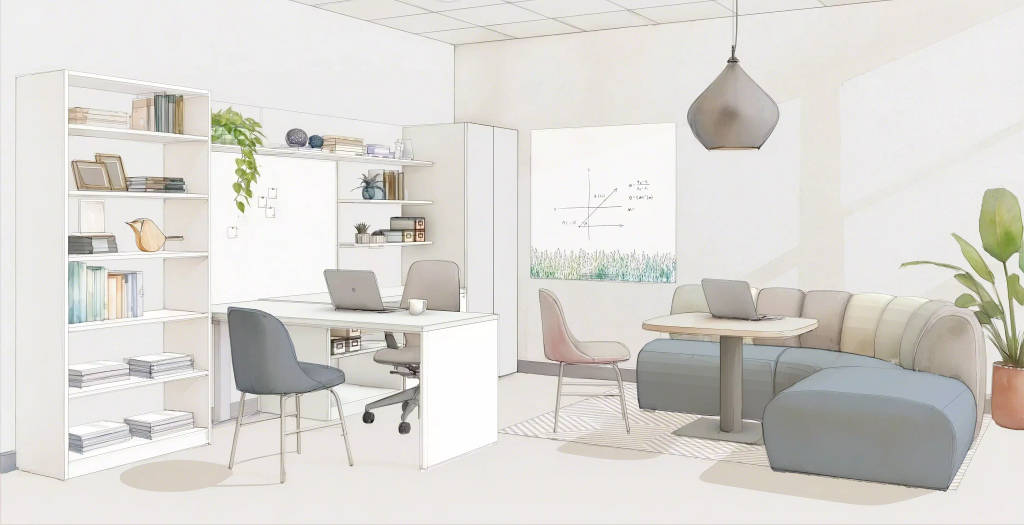
Design to support faculty and strengthen the institution
The research does not suggest the solution is a uniform standard. Instead, it points to design principles that help institutions align space with the full spectrum of faculty work:
- Design for flexibility and choice
- Design for deep thinking
- Enable collaborative modes, including hybrid needs
- Design for welcoming, inclusive experiences
- Design for wellbeing and comfort
These principles give planning teams a clearer brief. Not “How should this look?” but “What work must this support, and what barriers are we removing?”
Faculty connect institutional mission to everyday learning. When environments support evolving work across focused tasks, student interaction and hybrid collaboration, institutions are better positioned to thrive.
The research summary distills what’s changing in faculty work and what that means for offices, collaboration areas and student-facing moments.
Download to explore the findings and design principles that can improve engagement, retention and innovation at your school.