Culture + Talent

Transforming IT at Steelcase: An Agile Case Study

Foundation for Success

“A central question we had before embarking on this journey was ‘How can IT become a better business partner to the organization?’ We knew we had to develop our ‘true north’ principles that would lay our foundation for success.”

Tom Hunnewell, Director, Steelcase Information Technology.

Before designing a space or adopting agile, IT leaders identified five guiding principles central to achieving their desired transformation. These principles were the lens in which Steelcase adapted agile. They became the foundation for developing new processes and practicing new behaviors.

  • Our customer needs always come first
  • We value data as a strategic company asset
  • We are adventurous explorers of innovation
  • We are global systems thinkers
  • We succeed as a team

IT identified three types of teams based on the ways in which IT teams support their customers. These provided ways of understanding the unique needs for each kind of team.

Agile Team
A core team dedicated to one project or product with strong customer engagement.

Multi-Project Team
The simultaneous delivery of multiple projects to multiple customers for both project and ongoing work.

Discipline Team
Technology specialists with regular deliverables to one primary customer or multiple customers for ongoing work.
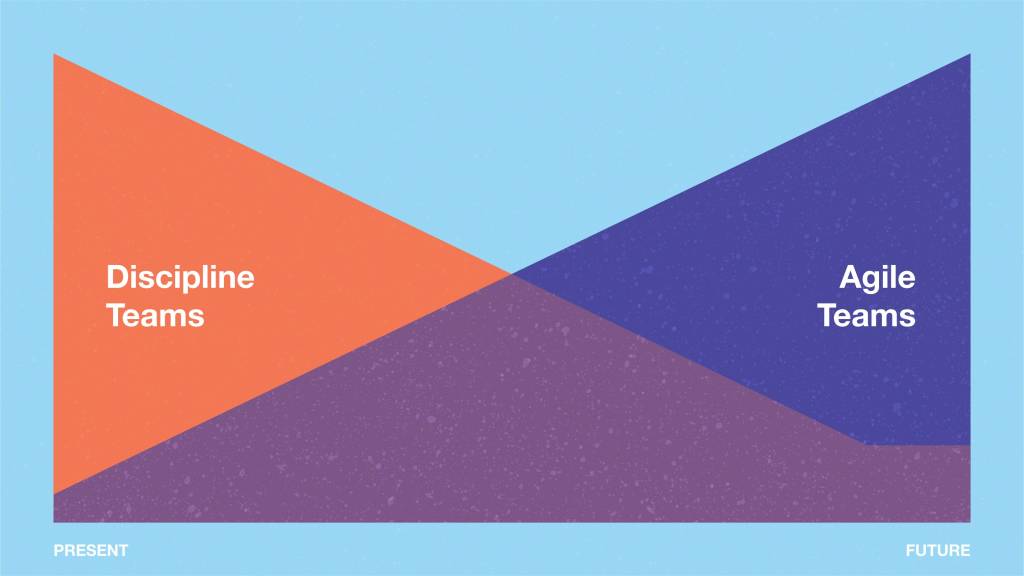
Currently, 10 IT teams are practicing agile and many more are discipline or multi-project. In the future, IT plans to transition more teams to agile, but ultimately will retain some discipline teams.

Over time, IT intends to transition more and more teams, so that the majority are working in agile ways. Although, not every team will practice agile to the full extent, the process isn’t the right fit across the board. All of the teams in IT are, however, beginning to adapt an ‘agile mindset;’ being more closely connected to their customers, less siloed and sharing knowledge in broad ways in the organization. In addition, many multi-project and discipline teams are starting to adopt agile ceremonies such as stand-up meetings and retrospectives.


NEXT CHAPTERBuilding the Practice
PREVIOUS CHAPTERWhat is Agile?


Table of Contents

Related Stories

Creating High Performance Culture with Khalil Smith (S8:E3)

Creating High Performance Culture with Khalil Smith (S8:E3)

Meetings offer one of the clearest windows into an organization — who speaks, how decisions are made, and whether people feel included all reveal the real state of culture and performance. Our latest research shows that when leaders pay attention to these everyday dynamics, culture shifts from something abstract to a measurable driver of alignment, fairness, and better work. Hear more on the Work Better podcast, where Khalil Smith, Vice President of Inclusion, Diversity, and Engagement at Akamai Technologies, unpacks the gap between what leaders think people need at work and what employees actually say they need.

(Read transcript) (Find in Apple Podcasts, Spotify or wherever you listen).

Why We Misunderstand Each Other at Work with Nick Epley (S7:E3)

Why We Misunderstand Each Other at Work with Nick Epley (S7:E3)

We think we know what our coworkers want – but we’re often wrong. In this episode of Work Better, behavioral scientist Nick Epley reveals why we misread even those closest to us, and how asking deeper questions can unlock trust, connection, and better collaboration. Epley challenges us to rethink small talk, lean into hard conversations, and design spaces that make connection the default – not the exception.

(Read transcript) (Find in Apple Podcasts, Spotify or wherever you listen).

Make Listening Your Superpower with Jeff Yip (S7:E2)

Make Listening Your Superpower with Jeff Yip (S7:E2)

Listening is hardest when it matters most – and many of us are doing it wrong. In this Work Better episode, researcher Jeff Yip reveals the five mistakes that sabotage our ability to truly hear others. Find out what they are, and learn why listening is the key to connection, engagement, and leadership – and how to start doing it better.

(Read transcript) (Find in Apple Podcasts, Spotify or wherever you listen).