
Leading Humans in the Age of AI with Erica Keswin (S7:E1) (Transcript)
Podcast
A human workplace is one where leaders realize that doing things that might be good for the humans in their office are also good or can also be good for the bottom lines of their business. And those 2 things are, they’re not mutually exclusive.
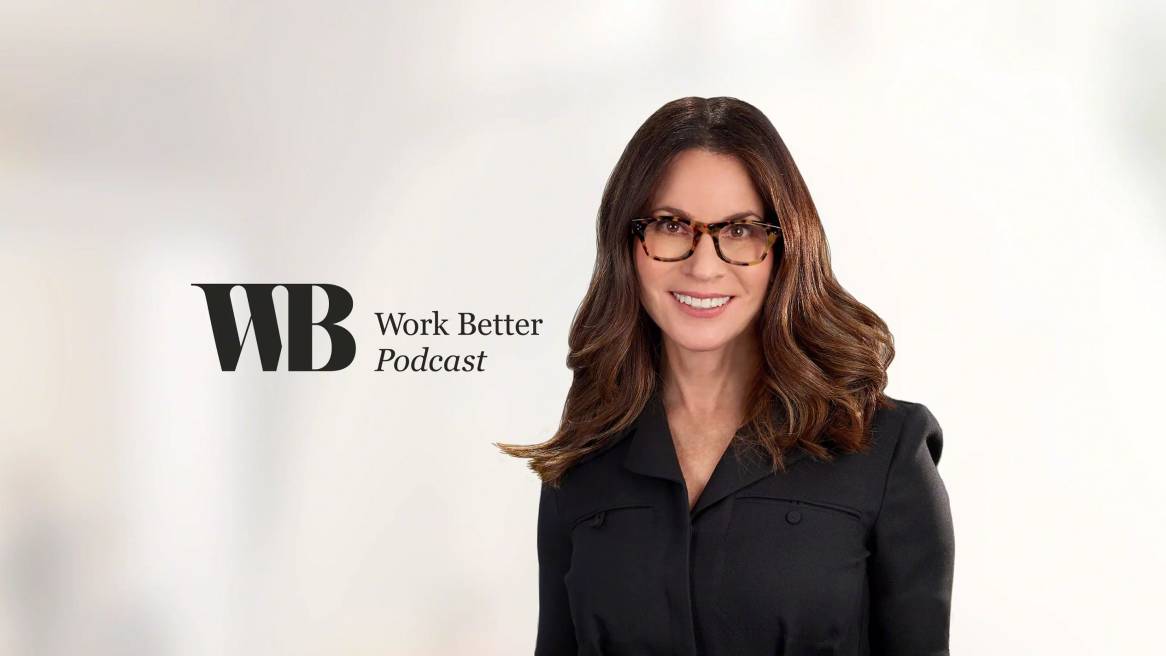
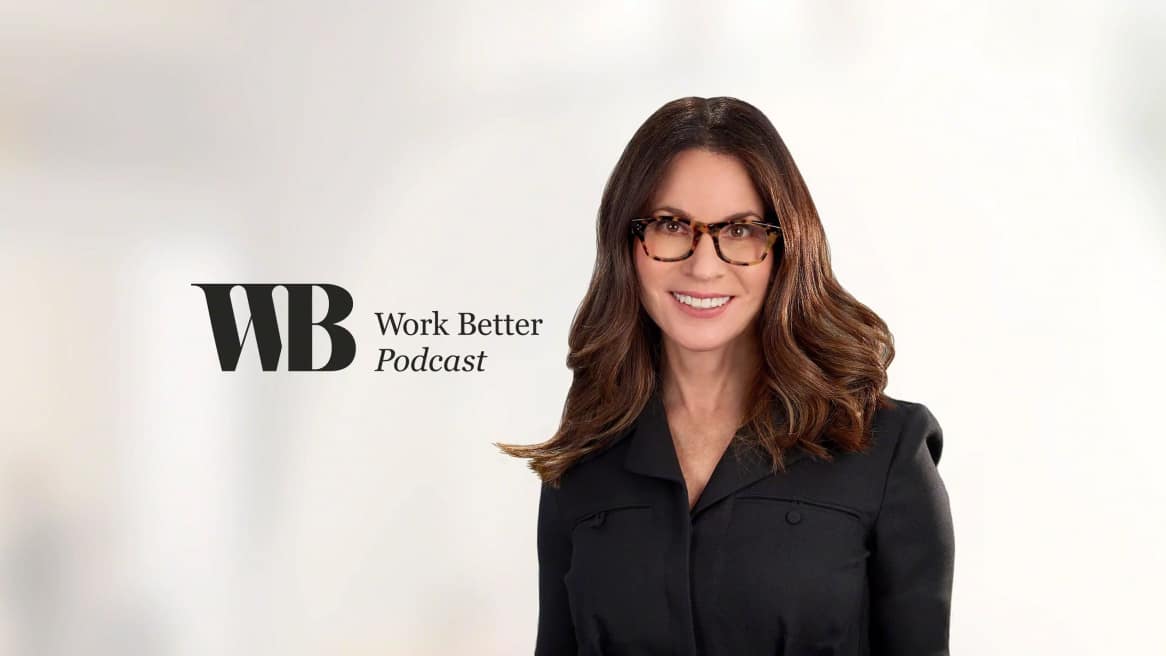
Welcome to Work Better. The Steelcase podcast where we think about work and ways to make it better. I’m your host Chris Congdon and my guest today is author and workplace strategist, Erica Keswin.
Erica is a workplace consultant, speaker and author of three books, Bring Your Human to Work, Rituals Roadmap, and The Retention Revolution. Erica is also a passionate advocate for helping people find the sweet spot between tech and connect, especially in the age of AI.
This is so cheesy, but I say it, anyway, which is “left to our own devices, pun intended, we’re not connecting, and it’s not going to happen on its own.”
Erica is also a mom to a very human dog, Cruiser, so I started the conversation there.
Chris Congdon: Erica. Welcome to work better.
Erica Keswin: Thank you so much for having me.
CC: Well, I’m I’m excited to talk about a lot of things with you, because you’ve done some really interesting work over the years, and I know that so much of your work is focused on humans at work. And you know, of course, we’re all human at work.
But I wanted to hear a little bit more about somebody else who is special in your life. I think you’re a dog person, aren’t you?
EK: I am. I have a dog who’s right outside right now a dog named Cruiser, and when I was writing “Bring Your Human to Work.” People at the time back then didn’t really even know what they meant. And they actually thought I was talking about my dog Cruiser, very human dog. But I was actually talking about actual humans.
CC: Yeah, I have a human dog, too, like, and I love to say, like, Hey, dogs are people, too. Because, you know, sometimes they have emotions, or they express emotions and feelings that sometimes, even as humans, we’re, we’re not always so good at. But so talking about your book, though, “Bring your human to work”, you know that was something that I find so fascinating, because, even though you published it before the pandemic hit, it feels like it’s really even more relevant today.
So let’s just talk a little bit about that. When you say you think we should have a more human workplace or human work experience. What is a human workplace from your perspective?
EK: So it is interesting. I mean, that book came out in 2018. So a couple of years, obviously, before the pandemic. And a human workplace is one where people honor relationships. You know, a human workplace is one where leaders realize that doing things that might be good for the humans in their office are also good or can also be good for the bottom lines of their business. And those 2 things are, they’re not mutually exclusive.
What are some things like that that could be having leaders who really think about curating connection, and when and how people get together. I mean, you’re in the space business, right? There’s a whole chapter in that book called Space matters. It looks at how humans interact in the workplace. And sometimes the ROI might not be immediately known to the person. But it is taking that leap and saying, you know, “what things that are good for people are good for business” Whether we look at increased engagement, job satisfaction, retention, all of those things.
And to your second point it is funny, it’s seven years since that book came out. And I’m talking more about that book, even within my other books right now, because in a post-pandemic world putting the human at the center is has become even more important when we’re not all seeing each other every day, when we’re trying to think about the role of technology and AI. So you know, you and I clearly are very aligned in how we’re thinking about this.
CC: So a lot of things have changed. But I just want to make sure I’m hearing you right that when you say, “honoring a workplace that honors relationships” that’s really creating an environment, the conditions in which fostering relationships is valued and seen as kind of a means to an end. If you will like, you know we’re going to be more productive, more successful in business people will be more highly engaged. Am I getting that right?
EK: Yes, a hundred percent. I mean, here’s the opposite: one of the things I often say when I give a talk or a workshop at a company is, “the absence of intentionality is a recipe for resentment.
And what I mean by that. It’s like almost the antithesis of somebody that doesn’t honor relationships. And this is happening in workplaces across the country. Employees commute in to their offices whether they’re in one day, 2 day, 3 days, whatever that is now in a post Covid world. They get there. Half the people on their team aren’t there, and they are doing the exact same kind of work they could be doing from home in their sweatpants. And so the flip side, you know, great human leaders know that they need to be more intentional about those moments when their employees do come together.
More true now than it was back then. From a data perspective, the data is clear when people do feel connected to others, employee engagement goes up, health and wellness goes up. We’re still in the midst of an epidemic of loneliness and isolation.
A recent survey that I saw found that 94% of people surveyed say they actually feel more productive when they feel connected to others. So it really hits on so many of the business levers that we need to think about when we’re running a company.
CC: Yeah, for sure. And I would just add, one of the things we learned in some of our research is the important role that leaders play that they don’t always recognize. If people don’t see their leaders on a consistent basis, they’re more likely to be disengaged. Have lower productivity numbers, feel less of a sense of connection to the organization.
So hey, Erica, I want to talk to you about the topic that everybody is talking about these days, of course, which is AI. And you know, I think everybody knows AI is going to, and it already is shaping behaviors at work. We’re changing the ways that we’re working. That’s something that we can’t ignore.
But a couple of things I’m curious about your take on this one. I was chatting with a couple of my colleagues earlier in the week, and we had seen this study. It was from Upwork, but I feel like I’ve seen similar data from other sources where they were saying things like “people who are heavily using AI in order to increase their productivity like they’re more likely to be burned out, they’re more likely to be disengaged, they’re more likely to quit”. I found that really worrisome, and I wonder what you think is going on there?
EK: You know whether it’s AI or in that example, I don’t know how different it is from other kinds of technology. My belief is that I talk about the importance of finding the sweet spot between tech and connect.
We want to understand the technology, and we want to leverage it for all of its greatness. We’re recording this right now. I’m in Aspen, Colorado. You’re in Michigan. We’re using all different kinds of technology and I feel like I’ve gotten to know you. We had a call before this call. But if this is the only way that people ever communicated, you would start to feel disconnected, and that there was a real loss. And so it’s up to all of us to leverage it for all of its greatness. But then also put it, quote, unquote in its place, to connect on a deeper level. And that gets tricky because we’re addicted to it. It gets tricky because sometimes it’s easier to default to technology. And it goes back to the point you made about leadership. I mean, leaders need to lead by example and literally walk the walk.
And that is on the AI side, here are the AI tools that we’re using, here are some governance issues which is definitely not my expertise. But then the other piece is, here’s what we want to use AI for. Here’s what we don’t want to necessarily use AI for, at least for right now, in this moment. And then the flip side is, here is how, when, where, why, we are gonna come together as humans and do the human thing.
This is so cheesy, but I say it, anyway, which is “left to our own devices, pun intended, we’re not connecting, and it’s not going to happen on its own.” And so the leaders who get it and I call them in my work, these are great human leaders even, and especially in the age of AI. They’re the ones that are going to create the kind of culture that comes out ahead.
CC: I read one of the stories that you were telling about trying to have a conversation with one of your friends and it didn’t really feel like she was listening. Can you tell us about that story? That technology.
EK: We were having a coffee and and I get it. I mean, I think at the time my kids were younger, and we always feel like, okay, if I have young kids, I need to be available. And I again, I always say that’s true. But there are also workarounds if you’re having a conversation with somebody, and you’re waiting for an important call from a doctor or a kid or an elderly parent. You can leverage the technology and set the phone to get that phone call. You don’t have to be staring at it every 2 seconds so that the person that you’re with feels crappy, right? They’re like, why am I wasting my time? And there’s now actually a term that’s called fubbing PHUB. And fubbing is a phone snub.
And I say to people, Well, do you fub? And people say, Well, I don’t know. What does that mean, you know, is fubbing, even appropriate at work. I mean, people are like, what on earth is that? Well, you probably do it because the data says that 89% of people pulled out a phone in the middle of their last conversation with someone and 82% of the people say that it hurt the conversation that they were actually having. And so it’s a problem. And one of the things that I often talk about. And I believe this is one of the greatest gifts as leaders we can give the people on our teams and in our organization today, and quite frankly anyone in our lives, is that gift of being fully present.
Yeah, you know. Imagine if you walked down the hall into a colleague’s office and they took their phone out and turned it upside down, put it in their desk drawer for the entire time you were with them.
CC: It’s almost unthinkable, right?
EK: I mean, I say, to these leaders like you want to have the people that work for you feel connected and engaged and not quit. You know this is in a good news way. This is not a rocket science, it doesn’t have to cost anything, to put your phone away doesn’t even have to be for that long. But again it goes back to the absence of intentionality is a recipe for resentment that you know, or this study that you cited, that people want to see and feel connected to their leaders.
CC: But one of the things that really struck me and you talked about this after you went to the Aspen Idea Festival, and I think you it was Brene Brown: talking about AI and the human spirit. And what I thought was really interesting is some data that I’ve seen about people, 90% of workers seeing AI as a coworker. It’s great. But people are starting to trust AI more than some of their colleagues, and some are even saying like that. They think that AI is better to work with, because it’s more polite, it’s more responsive. What do you think is AI like making humans look bad?
EK: Those numbers to me seem high. I mean, when I first saw that I thought, Well, maybe these people have not had the experience, at least, that I’ve had with all of these AI hallucinations like has gotten a lot of stuff completely wrong. And so I think that we need to use it as a tool in the same way that we use other tools.
But I don’t know I’m not there yet. On, on many of those statistics, you know. I think that AI can give you great data analysis. Anything that it cites you need to triple check those citations.
I think AI can help understand your voice and help you with some writing. But AI can’t read the room, right? If you give feedback to an employee, AI, you know, can say, “here’s some.” I could input, “here’s some things that’s going on with this employee.” I have no idea how to talk to them. I can go back and forth and get some great data points. But AI is not going to know, when might be the best time to actually have this conversation given all of these other extenuating issues.
So to me it goes back to that sweet spot. Let’s continue to try to figure out what it’s best for at this moment. I think it’s gonna continue to improve. But I don’t know. At least, for now maybe I’ve just had great coworkers that haven’t gotten a lot of stuff literally completely wrong.
CC: Well, you know what we were, I was saying with my colleagues. As we were talking about this, I said, Well, yeah, I mean, I can see where AI could be appealing, because, you know the AI it tends to be just whatever it is you want. It’s like here, “let me help you.” But humans are messy. You know, we get a bad night’s sleep, and maybe we come in grumpy, or we get distracted, and maybe we’re not great listeners. But, AI is never going to love you back. You know it’s like for all of its advantages, even if you go on an AI date, you know, and it can be charming. It’s still, it’s not human. It doesn’t have that messiness that we love about humans.
EK: I’m doing a lot of writing about the messiness. And I think we need to lean into the messy. You know it’s the right amount of messy. But I think, as we go forward, it’s those leaders, you know, it goes back to. When we were talking about during the pandemic, the leaders who saw their employee engagement and sense of connection go up even in a virtual world, had a willingness to be vulnerable, and had a willingness to be messy. And reduce that and start to become more like the AI and more robotic and we lose some of that messiness, Aka humanness.. I don’t think it will be great for business overall.
CC: Yeah, yeah, I agree with you a lot there. So do you think it’s possible that, like AI could help us be better leaders or more empathetic, you know. Are there things that we can learn from AI that you think would help us? Or would you just say, no, that’s not really the sweet spot for this too?
EK: So I think again we need to leverage it. But I think we can’t just literally take exactly what it gives us, and you know, implement it, leverage it. There still needs to be this human intermediary. Because I worry, one of the other studies that has come out recently through MIT just talks about how AI is just making us just dumb.What I don’t want to see happen is, we sort of, take all of it with a grain of salt, and not process it in a way to say, “okay, well, how might this work in reality?” Or this sounds great for all employees that might be dealing with a certain issue. But I know that this person has this other extenuating issue. We still need to do that, that dot connecting or threading of the needle. But I think we can leverage it and learn a ton that will help us become better leaders for sure.
CC: We might be using different words, but I think we’re talking about the same kind of thing at its core. We’ve been thinking a lot about community, like creating a sense of community at work, because in our work we found that people who do feel a sense of community are more likely to have a shared sense of accountability, or they’re more likely to feel higher levels of trust. And all of that leads to the good business outcomes that we were talking about earlier, like productivity and engagement, etc.
And so I’m curious about some of the things that you’ve been learning about just building those experiences at work. You mentioned this before, and I know so many of our listeners and organizations are dealing with getting the right balance. Still, 5 years later, between how much people are remote, how much they’re in the office, and I’m curious if you have any thoughts about what we could be doing differently? That would help people feel even more connected at this time that they might not physically be connecting as much.
EK: So in my most recent book, the Retention Revolution, this sort of dates me or shows my age. But you know, as a kid. I watched the love boat and on the love boat there was a woman named Julie McCoy, who was the cruise director.
CC: I actually know who that is!
EK: There you go! Some of your listeners do, too. But she was a cruise director, and she curated connection. And so a best practice that I see in organizations again, whether you’re in the office, whether you bring your people together 4 times a year, or 4 times a week, or 4 times a month, is, that is that they’re curating connections, and they’re not leaving it to chance.
CC: What does that look like? What do you mean?
EK: So so pre-covid, just because we were all in the office all the time together, people still felt lonely and isolated, and still said that they felt sometimes that they weren’t really connecting.
So what does that look like at the highest level? And this I’m gonna sort of share my own feeling on this. Not everybody agrees, but some of the companies that I find these days that are really struggling, they say, “okay, we’re gonna come in 3 days a week, and everybody can come in whichever 3 days you want and great, you have flexibility.”
And you presumably have connections. But Chris comes on Monday, Tuesday, Thursday, and Erica’s coming Wednesday, Thursday, Friday. They overlap one day, and we don’t necessarily make a point to see each other. So everybody, it’s like ships passing in the night.
Curating connection is putting a stake in the ground, realizing that you’re not, gonna you know, not everybody’s gonna be fully happy with you. It’s not about you having people connecting every minute of every day, but it is having these touch points.
I always say, you know, approach this through the lens of I see my recipe is sort of one:approach it through the lens of vulnerability. We’re all trying to figure this out. You know we had experienced Covid, and you know even myself, as the leader may not get it all right.
Approach it through the lens of empathy. I know that you, you know, only had your dog sitter 2 days a week, or whatever that is, but we’re going to figure this out.
And then the 3rd is through the lens of experimentation and and also telling people, you know what we’re gonna try this. It may not work, but we’re gonna iterate. And we’re gonna figure it out because we know we wanna have flexibility. But we also know that connection is critical, not only for you as humans, whether you’d like to believe it or not, but also for our company.
CC: Yeah, I I think that’s a really good insight. So the vulnerability? Sorry. Say it one more time. The vulnerability, the empathy and experimentation. Those are really good points to think about. I am not sure every business leader, feels totally comfortable about being vulnerable. For those of us who’ve been around a while sometimes we learn that you’re supposed to be kind of in the know, the people have deep experience. You’re not supposed to be vulnerable.
EK: Imagine if for me at least, if my boss all of a sudden says to me, “okay, 4 days”, and my vulnerability could be like, look, I got to figure out how I feel about this, and I’m in the same boat as you are. I’m trying to figure this out. It doesn’t have to be, when I wrote, bring your human to work, people will often say, well, “how much human?” I mean, this is still work. So we still need to be and talk about work things.
But I do think it’s okay not to have all the answers, and especially when we think about retaining Gen. Z. And what Gen. Z. Employees want from the workplace.They want people to be authentic, and they want to feel meaning and connection at work. And so I think, for those of us that might be less comfortable with it. You just sort of give it a shot.
CC: And I’m curious. I know that you are not an interior designer by trade, but given the amount of time that you have spent thinking about like humanity at work like, do you have any thoughts for us? Those of us who are focused on space like what are some of the things that you would say, boy, I’d really love it if you guys would prioritize this, or if you’d address this problem. What do you think?
EK: So when I think about space you know, it’s a couple of things. I mean, there’s this, I know there’s a you guys are experts in this. But from where I sit watching the trends over the last bunch of years it was like everybody had an office. Then everything was an open office, and then. Now there are some offices, and the hoteling, and all of these different trends. I think to me it goes back to the intentionality behind the space and being really clear with people around that intentionality.
I think you love when I go into offices, and I at least, when I was back in your office in like 2015, I remember there was a really cool space that almost felt like one of those 3rd spaces. It felt like a Starbucks where I could sit there and get my work done. But if somebody came next to me I wasn’t trying to be in the library space where I was trying to do deep thinking. And so I do think we want to make sure that people really do, especially now, when many people were used to working at home when they had that quiet. Unless, of course, they were in a New York City apartment with 8 people, most people had quiet, and now they’re they now they complain. “Okay, I’m being pushed back to the office. But where am I going to do that conference call?” We sort of need to match some of the physical needs to what people are thinking and feeling from a business perspective.
And then the other thought that I am hearing a lot lately. I guess I’d be curious as to your thoughts on this, because I’m hearing a lot is post pandemic many organizations got rid of some of their space. And now, having everybody come back to the office, there’s not enough room. So my feeling is. and when I say to them, Well, okay, I don’t love this strategy of 3 days in the office, and everybody can pick whichever 3 days, because it’s like a lose-lose. And so to me, what they need to think more about is well, look at those days that we are in the office, ideally, we’re doing the kind of work where we are in a group setting. So we don’t have to worry about everybody having a desk, and I know that takes a lot of planning and strategy around it. But I think it’s pretty critical to both leverage the space, but also make sure that people are using it in a way that’s additive. Maybe the pendulum’s gonna swing back. And all of a sudden I’m sure the people in the commercial real estate world are going to be psyched if people try, you know, start needing more space again. But that’s a little above my pay grade.
CC: Yeah. Well, I think you’ve nailed it, that there are a lot of organizations that did let go of some of their real estate. And now, through experimentation over the past few years, they’re learning that they feel like they’re better when they’re together. They want people to be coming in at least 3 days a week, 4 days a week, some going as far as 5. It all depends on the company’s goals and culture.
But so what do you do about that when you’ve reduced your real estate and one of the things that we’ve done in our own spaces, and that we’ve done a lot of research about is really starting to think about your office instead of it being like a factory model that you know where people are in rows and rows of cubicles, or rows and rows of private offices, and we know that people like to have their own space.
But what if you thought about your workplace more like, I’ll go back to the word community. Like, if you think about really successful communities, cities they have, they’ve done things like they have multi-use spaces. They have residential spaces which could be equivalent to your individual work areas. But they’re right next to urban parks where people can sit and relax and have maybe some quiet that you know to your point, people need to have a place where they can either get some respite, or places like you know your condo, your apartment, your house, like I have a place where I can get away.
And I think if you apply that kind of thinking. It’s a lot more flexible than some of the things that used to be done a while ago. But I think inherent in that idea goes back to what you’ve been writing about and talking about for a long time now, which is the core, is human beings and honoring those relationships between people creating the conditions where people can really build those relationships.
Hey, before I let you go, I just want to know if there’s any other thoughts? You know, I know you’re at the aspen idea fest you get to meet with a lot of different organizations. Do you have any other kind of parting words of wisdom that you want to share with our listeners today?
EK: I would say, if I had to pick one thing, maybe to sum up a lot. I mean, we’ve talked about so many great things today. It’s that we, one of the things we need to think about and really be conscious of, is that the default use of technology degrades connection. In my opinion, again, it’s that default use. So before we start defaulting to always having that technological response, we need to think about all you know again how to leverage it. But if we believe that connection in our lives is important, which I think most of us would agree that it is. We need to sort of take that pause before we always default to technology.
CC: I think those are really good words of wisdom. Technology can be a really important tool, but it can’t be in the middle of every relationship that we have.
EK: Although it’s funny, I’ll say one last thing, because this is sort of where you started the conversation, which I had no idea you’re actually gonna ask me which is about my dog. You were both dog people. And actually, I’m going to send you a picture at some point later. But my dog’s collar. His little tag has his name and his phone number, my phone number. But then it says, 80% human, 20% Labradoodle. Think about your connection and relationship with your dog other than maybe facetiming your dog when you’re away, that relationship is is not based on technology.
CC: Not even remotely. It is all based on belly scratches and treats. Erica, it’s been so much fun talking with you. I’m just really grateful that I know how busy you are, so I’m grateful that you took the time to join us on work. Better. So thanks for being here.
Erica: Yeah, I loved it. Thanks so much for having me.
CC: One of my many take-aways from Erica is that we all have to be the cruise directors of our work relationships. With so much technology at our fingertips, we have to be intentional about curating connections at work.
If you want to hear more on this topic, check out Season 3 Episode 8: The Power of Civility and Community with author and researcher Christine Porath.
Before you go, remember to share the episode with a friend or colleague, follow us and visit us as steelcase.com/research to sign up for our new weekly newsletter on workplace research, and design ideas delivered right to your inbox.
Thanks again for being here and we hope your day at work tomorrow is just a little bit better.