
Creating People-Centered AI Spaces
AI moved past the early adoption phase and is now a key medium through which work happens. It’s changing people’s behavior as they work individually and in groups, creating an urgent need to rethink the office. Leaders are ready: 78% in the US* believe AI will lead to an office redesign within the next few years. Industries are shifting unevenly: frequent AI use is highest in technology, followed by professional services and finance, indicating where pressure to change work settings may be felt first.
Leaders use AI to consolidate and automate; individual contributors lean on it to brainstorm. The “how” matters: treating AI as a creative, strategic partner saves 105 minutes a day vs. 53 minutes** when it only speeds existing tasks. Still, the pace and learning curve take a toll — 37% of AI users report stress or burnout,*** and heavier use correlates with more strain.
Teamwork is also shifting to a new rhythm: solo with AI, in person synthesis, then digital follow-ups. Nearly half of AI users tell Steelcase it changed how often they connect with colleagues (78% more, 22% less***). As people toggle between AI dialogues with agents on screens and human moments to build context and make decisions, workplaces must adapt or risk becoming a barrier to productivity and wellbeing.
New Steelcase research finds 35%*** of AI users say it changes how they use their physical workspace. Across the day, AI accelerates flow: triaging inboxes, drafting, summarizing,
synthesizing. Focus sessions now include back‑and‑forth with AI to explore possibilities and refine ideas. Team time is used to build on, challenge, verify ideas and develop a point of view.
Social moments become crucial for relief from screen intensity and vital for building trust.
This shift raises practical questions:
Where does critical thinking happen? AI can hallucinate and introduce errors; teams need visible, shared spaces to review outputs together without hijacking attention.
How will we support wellbeing? Burnout risks and increased screen time make rejuvenation and genuine human connection essential design criteria, not extras.
How do we integrate tech and space? Camera angles, acoustics, lighting and cable management influence how AI “sees” and “hears” work, affecting equity for remote colleagues and the accuracy of AI‑enabled capture and summarization.
As AI changes the workplace, the opportunity isn’t just to adopt new tools — but to shape the behaviors that help people work better.
Three Ideas to Support Emerging AI Behaviors
The most effective response is not a single “AI lab,” but a coordinated ecosystem that supports focus, collaboration, socialization, learning and rejuvenation. The Steelcase Community-Based Design approach treats the workplace like a resilient community, with mixed-use “districts” that flex as teams shift modes, each equipped with the right technology and sensory conditions built in.
.
Focus: AI dialogue, human review
Behavior to support: Today, people may seek a quiet, private space to focus and open areas for spontaneous teamwork. AI is shifting that pattern. Someone may need privacy to work with an AI agent, followed by deliberate human collaboration for critical thinking and verification.
How it works: An enclave provides privacy and dual monitors for chatting with AI agents while creating content. Task or lounge seating lets people to change postures and stay energized. An all-in-one docking station offers quick technology setup. An auto-framing camera and noise-reducing microphones improves remote meetings. An adjacent front porch encourages
collaboration with colleagues (see image below).
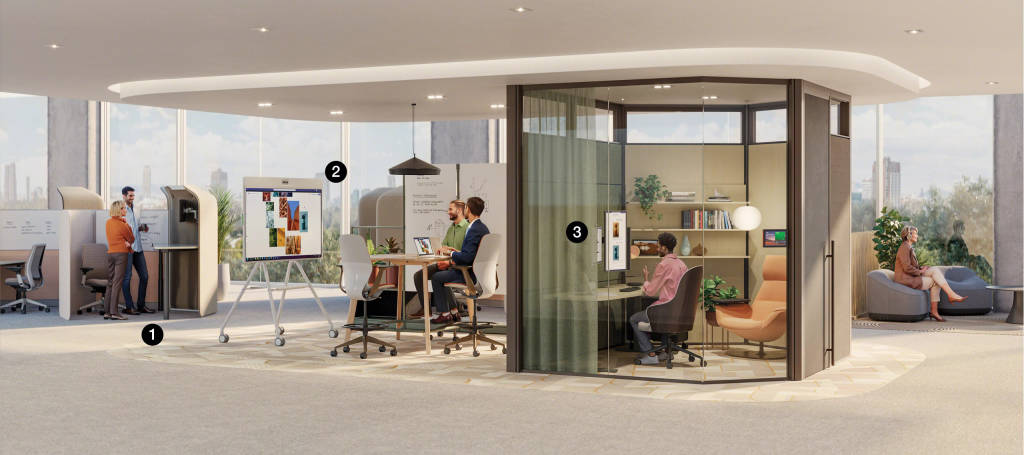
- Tech-enabled back-to-back workspaces balance visual privacy with transparency and learning.
- The enclave’s “front porch” lets people transition quickly to collaboration. Logitech Rally Board 65 with AI-enhanced camera and acoustic fencing mitigates noise.
- A tablet and ceiling speakers let anyone customize their own soundscape inside the enclave.
.
Collaboration: Flexible project rooms with microzones
Behavior to support: Temporary project teams spin up quickly to keep pace with work. People need spaces where they can switch among informative, evaluative and generative collaboration — sometimes with AI capturing notes and surfacing insights, sometimes with remote colleagues joining.
How it works: Collaboration rarely stays in one mode for long. A reservable, multi-week
project room with microzones gives teams flexibility to move between different types of
work without breaking momentum. Instead of forcing activity into a single meeting setting, the
space adapts as collaboration evolves.
Informative collaboration happens when teams share updates, align on context or onboard new members. Large digital displays enlist AI to update progress, timelines and action items. Settings prioritize clear sightlines and consistent audio so everyone can see and hear each other. Individual workspaces have visibility to digital displays, making it easy to immerse new team members. Plus, these spaces allow for quick ad-hoc connections (see image below,
left zone).
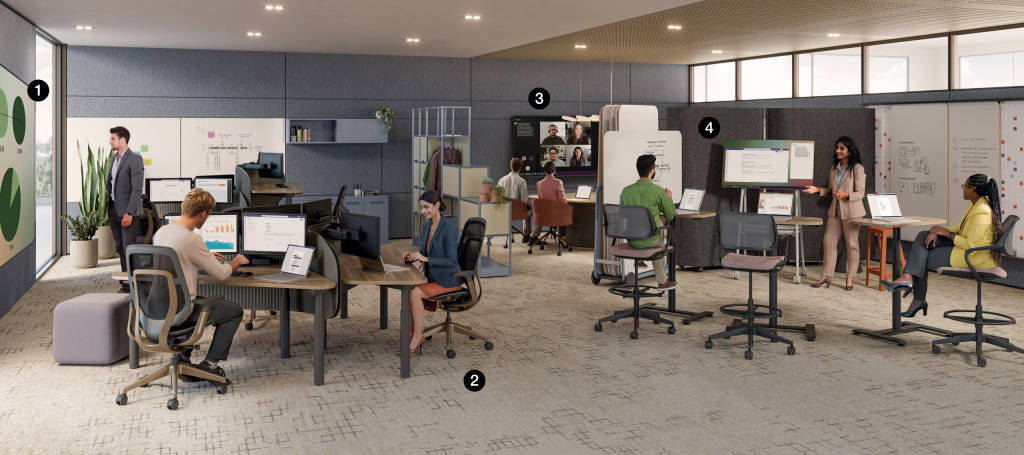
- An always-on AI-assisted dashboard provides information on progress and action items.
- Team members easily move between focus and team-based work as they use AI individually and in small groups.
- An eye-to-eye setting with just-right lighting is designed for equity, whether in person or remote. Cameras with object detection frame and label each person.
- A mobile digital display, digital markerboard and stools encourage active engagement. AI takes notes and provides real-time updates.
Evaluative collaboration turns the team’s focus to comparing options and making decisions. This area (see image above, upper right zone) balances visibility between people and content, enabling the review of multiple sources at once. Thoughtful acoustics and lighting reduce cognitive load. Integrated AI supports content capture, transcription and summarization, helping ensure information is shared equitably even after the session ends.
For generative collaboration, teams need to explore, iterate and build together. Writable surfaces, large shared displays and reconfigurable furniture support movement between divergent and convergent thinking. Ideas flow effortlessly from analog to digital, with AI helping synthesize inputs while preserving the group’s creative energy (see image above, right zone). Together, these microzones create a project room that supports how collaboration really works — fluid, layered and deeply human.
.
Socialization: Human connection counters screen intensity
Behavior to support: Heavy AI and screen use can increase stress and isolation; design spaces to maximize face‑to‑face moments to keep teams resilient and refreshed.
How it works: As people spend more time working on screens, spaces designed for social interaction should promote eye contact and meaningful moments together without digital interruptions. Ambient AI is integrated into this social hub to support how people engage. A coffee bar invites casual chats, spontaneous exchanges and group conversations. People can choose from a range of postures and settings to relax, recharge and reconnect in a calm, nature-infused environment (see image below).
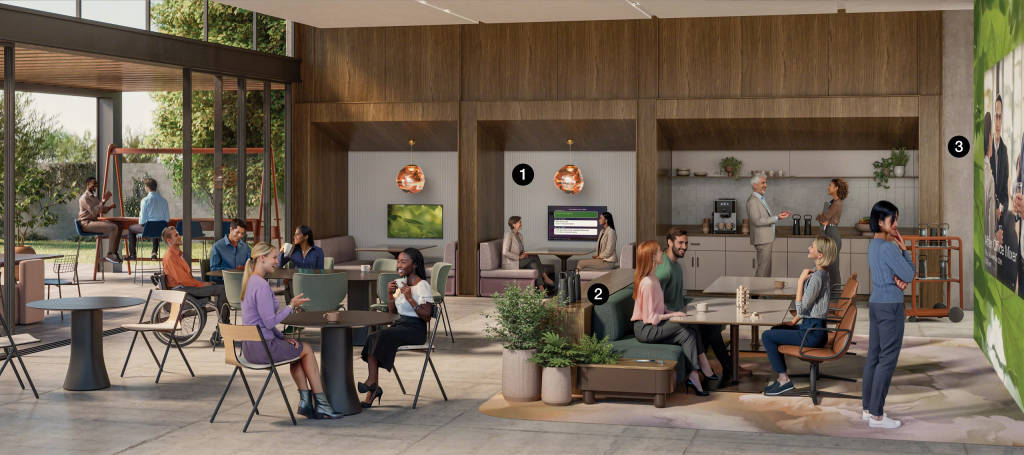
- Nooks equipped with AI translation technology facilitate real-time multilingual conversations and allow people to casually share content.
- The lounge rail, side work table and mobile cart provide power, so devices charge out of people’s direct line of sight, discouraging digital distractions.
- Technology blends into the space with a digital wall that displays information or transforms into visual art.
.
Bringing It Together: A Community‑Based Workplace
As AI reshapes tasks and teams, these design ideas work today and allow organizations to adapt as technology advances. The goal is not to build an “AI office,” but a human‑centered workplace where technology amplifies curiosity, creativity and collaboration — the enduring sources of competitive advantage.
*Steelcase U.S. leader research, 2025, **Atlassian, 2024, ***Steelcase global employee research, 2025