
Creating A Curious Organization with Stefaan van Hooydonk (S7:E4) – Transcript
In the beginning of things, in the beginning of a relationship, in the beginning of a new customer, beginning of a project, we’re all leaning into more questions and to more listening. We are allowing ourselves to be more curious. And after a while we settled to this new reality, we settled to this status quo and we stop exploring it.
Chris Congdon: In a world where we’re constantly pushed to be faster, more efficient, more certain, curiosity invites us to slow down, ask better, harder, questions and stay open to what we don’t know yet. But that requires humility, courage and a whole lot of psychological safety.
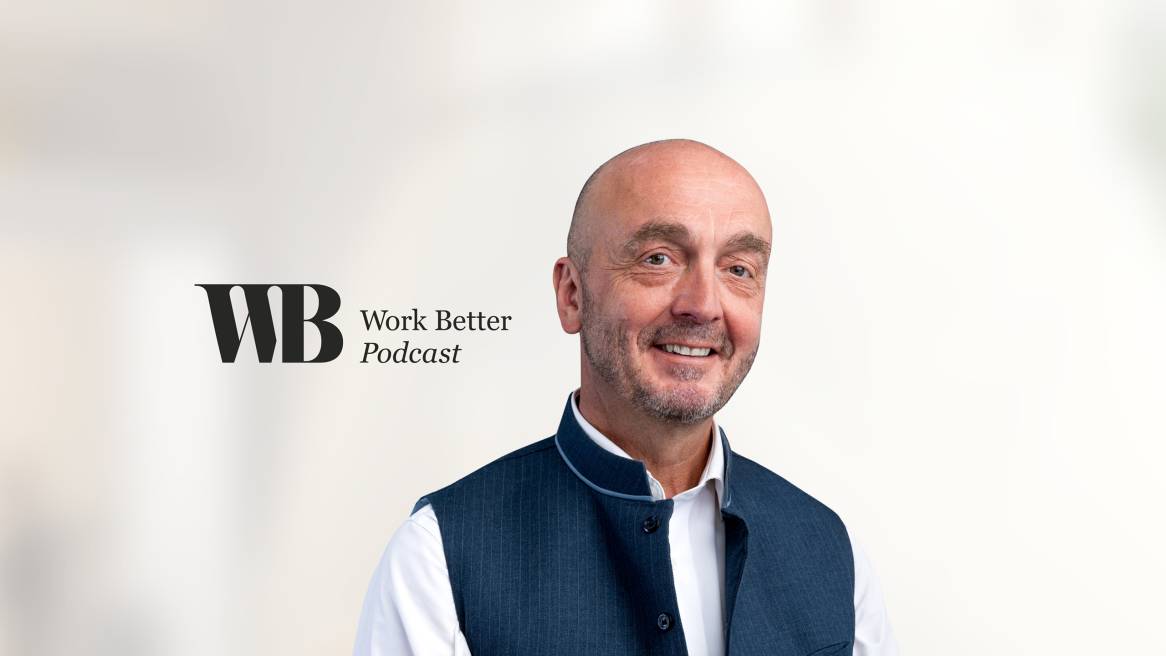
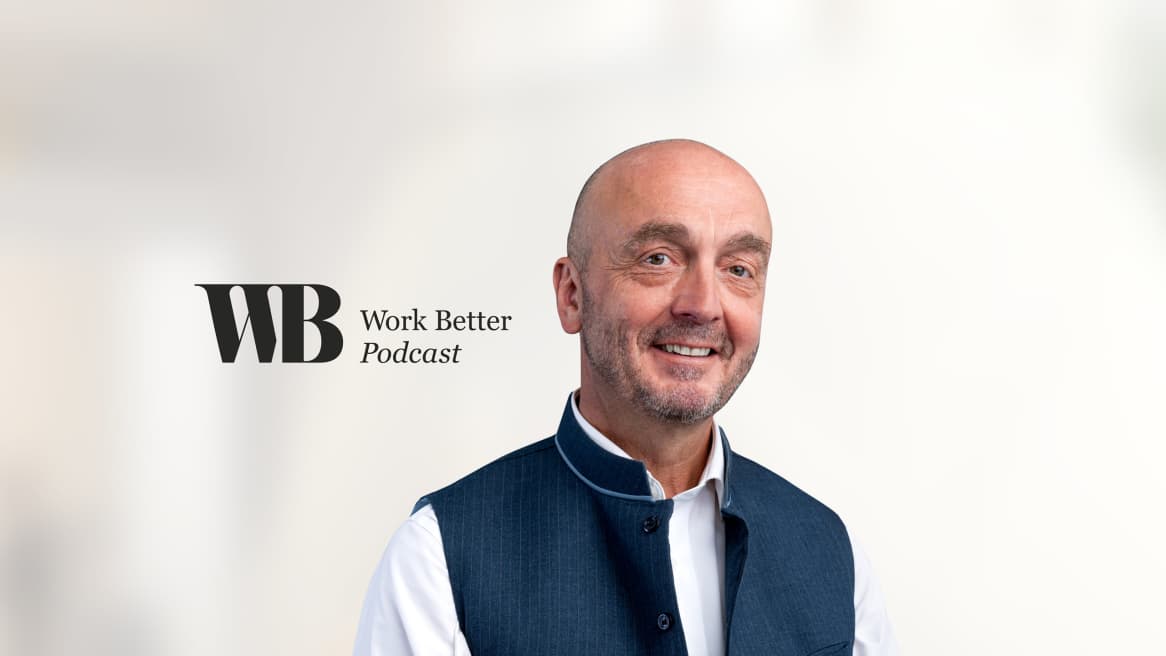
This is Work Better. The Steelcase podcast where we think about work and ways to make it better. I’m your host Chris Congdon and my guest today is Stefaan van Hooydonk. Stefan is the
founder of the Global Curiosity Institute, and a leading voice on how curiosity can shape better leaders, better cultures and better business results.
Stefaan defines curiosity as the mindset or the will to challenge the status quo. And according to him, when we get out of our comfort zone and ask the difficult questions, it pays off big time for organizations.
Everybody wants to work for an organization that is curious, because curiosity means exploration. Curiosity means that I’m empowered to learn and to grow faster than other companies. And curious organizations create environments where there’s psychological safety and where people have a growth mindset and where people can kind of drive things forward.
We talk about why curiosity often gets pushed aside at work. How leaders can create space for it, and how the places we work can open our minds to new questions.
Stefaan joined me from his home in Belgium.
=======================================================================
CC: Thank you for joining me today, Stefan.
Stefaan van Hooydonk: Thanks Chris. Let’s do this really looking forward to it.
CC: Well good. Because I am curious about curiosity and, and I’m really curious about what caused you to start studying this. Like, it feels like sort of an unusual topic to really dig into and so I wanna spend some time there. But before we get started, I first have to just ask a question about you from your youth because when I was looking at one of your books, you started out by describing yourself as a 12-year-old who wanted to learn Sanskrit. And I’m just really curious about what on Earth made you as a 12-year-old think that that was a thing to do?
SV: Yeah, it’s actually quite strange.
You know, as a 12-year-old I studied Sanskrit and as a 15-year-old, I studied modern Greek, and often, I think often we self subscribe. When you think a little bit about this, well often we think of ourselves as being really curious, as if the environment has nothing to do with this. Actually, what I found, this is just half the truth. About 50% of our curiosity is driven by our internal drive to challenge the status quo, learn something new to explore.But it cannot be done by external factors.
For instance, my father was reading a lot, he was reading three, four books a week. And he was this great role model for me to try new things. Or sometimes my parents would take me out of school and take me to exhibitions and museums. And they would write in a nice note to school saying, but for family reasons, Stefaan couldn’t be at school today. And you know, that already gave me the grounding, the permission, the opportunity to learn from really great parents and have role models. And when you think about that, I think a lesson like curiosity is only 50%.
So I might have been a little curious kid, but I could only do this because I had a great environment that created a time and space for me to be curious. So I wasn’t that special really. I just had special people surrounding me.
CC: Yeah. Well, I mean, it is interesting. What I’m hearing you say is, you know, some of our curiosity is maybe innate, but without having kind of an enriched environment or the encouragement, you might not develop your innate curiosity as much.
So let’s talk a little bit more about curiosity as just a general topic, and I’m interested in hearing what you think about, what curiosity really is like. How do you define it and what do you think it really means to be truly curious?
SV: Now let’s also stay a little bit with your previous question because when we’re talking about external factors, it means that the role of a leader is so important and the role of a company is so important.
Link with that definition – for me, curiosity is the mindset or even the will to challenge the status quo. My status quo of knowledge about the world, but also my status quo in my relationships and even my status quo in me and myself. Like that’s a function of self-awareness and self-reflection.
And so it’s the mindset that challenges the status quo, and it’s really hard. Like in the beginning of things, in the beginning of a relationship, in the beginning of a new customer, beginning of a project, we’re all leaning into more questions and to more listening. We are allowing ourselves to be more curious. And after a while we settled to this new reality, we settled to this status quo and we stop exploring it. And we also do that in our intimate relationships. In the beginning, we’re all very curious about the other person, and after a while we think we know the other person. We stop asking questions.
So have that humility and that courage to constantly ask yourself, am I still on top of things? Am I learning faster than the rate of change around me? And that can be done at the level of stuff, material stuff, learning, reading books, learning about new tooling, AI that’s around the corner or really kind of in the house, but also my relationship and my myself.
CC: Well, I wanna ask a little bit about relationships because when you said that, it reminded me of, it was another podcast that I had listened to, and in it, the guest was describing a new relationship or actually a relationship that didn’t go anywhere because the other person never asked her any questions about herself.
He explained things about himself, but didn’t really ask anything about this other person. And the way that that made her feel was like, well, you know, you’re not interested in me. And it’s interesting to me, this idea that our curiosity within relationships like, that can begin to kind of taper off. We assume that we don’t need to know anything new about other people in our lives. Is that kind of a pattern that you think just happens to all of us, or can we change that pattern?
SV: I found that after three years, our curiosity tends to taper off. We settled in this new reality. We asked less questions. We’re listening less. We’re, we’re less open to changes and we think we know. And now it doesn’t mean that curiosity leaves the house or leaves the station. It means that we have to try harder, that we have to come up with new strategies to keep curiosity alive.
And that is first of all, giving yourself permission. To say, okay, maybe something I’m, missing here. Maybe I have to learn faster or have to kind of lean into this curiosity again. And it also links to awareness. What is my curiosity parameter tell me? Am I running on automatic pilot my relationships or move my customer? Or, am I still asking really some of those fundamental questions?
And it’s still hard. I’m sometimes asking questions when I’m dealing with management teams and one question is, what can I do to be a better dot, dot, dot, for you and you can kind of fill in the relationship maybe what can I do to be a better boss for you? Everybody can do to be a better partner for you or better spouse. And I call that the better question. Sometimes it’s a frightening question to ask your subordinates.
CC: Yeah.
SV: What can I do to be a better boss?
CC: I’m not sure if I wanna know the answer to that question. Right. So why ask it?
SV: You, you see? Because it requires humility and it requires courage. And it’s easy to say that we are curious people, but when confronted with questions like this, suddenly we ask ourselves well. It’s magical curiosity if we ask the questions, but sometimes we create some barriers to asking such questions and to really lean into this curiosity with humility and courage.
CC: And I think the way you’re defining it with that ability to, or the willingness to challenge the status quo, I think is a different way than maybe I’ve thought about curiosity and maybe some of our listeners have thought about too.
And I really found it interesting when you noted that curiosity is something that is an adjective that’s showing up in more and more job postings. When organizations are looking for people to come join, they want people who are curious. And, you know, I started out my career in journalism, which I would think is like, you have to be curious to do that line of work. Maybe not all of us think about curiosity as a trait that we need to bring with us into our job. And so I’m just curious, literally, what is it that organizations are trying to solve for? What do they need when they’re putting that in the job descriptions that I want people who are curious to apply?
SV: Well, it’s absolutely right when you’re looking at, for instance, online job posts. There’s a 90% growth year on year of the use of the word curiosity. So companies are starting to realize more and more to the tune of 90% increase every year that curiosity sells. You want to recruit better and more candidates to the job postings that use curiosity.
And everybody wants to work for an organization that is curious, because curiosity means exploration. Curiosity means that I’m empowered to learn and to grow faster than other companies. And curious organizations create environments where there’s psychological safety and where people have a growth mindset and where people can kind of drive things forward.
You know, so there’s all this goodness. Not that all organizations are beacons of curiosity because actually what is important is to also talk about the opposite of curiosity, which for me is conformity. And conformity is all about keeping, and curiosity is all about seeking. Conformity is all about kind of playing not to lose and curiosity is about playing to win. So organizations are often more geared towards conformity than towards curiosity.
CC: Well, I wanted to ask more about that because, you know, the old phrase, curiosity killed the cat. Are there times where too much curiosity is not a good thing? Like if you’re challenging the status quo in ways that it’s gonna be hard for people or organizations to accept, do you think like there’s a balancing act there, or should we just say curiosity is always the right path? What do you think?
SV: I think curiosity killed the cat because language was very common about 50 years ago. And there’s still remnants of this old language in our language and in all languages. You have this in Polish, there’s a saying, curiosity is the first step to hell. Or in Romania there’s a saying that, uh, curious people die young.
CC: Oh dear.
SV: And we all have this love, hate relationship with curiosity because it goes against the grain.
CC: Ah-huh
SV: And at the end of the day, it goes against the grain of normal thinking
So of those two, curiosity and conformity, conformity is a stronger one as we explained. And, and back to your point earlier about the, you mentioned about your friends who are the partner were not really asking questions. For me, that’s the difference between being interesting and being interested.
Because when you’re being interesting, you’re always looking for yourself, from your own perspective, and you’re trying to almost, you don’t really care about the other person. You want to impress the other person. You want to kind of prey on the other person or snoop, and that’s always negative for the person that you’re dealing with.
If on the other hand, you’re more from a perspective of, I’m interested, you’re always going to be more looking out for the other person. Be more empathic, and you’re always going to treat the conversation with care and dignity. If you’re starting from that attention, then you are, you’re always going to be on the right side of things.
CC: I love the way you express the difference between being interesting versus interested. And as you were talking about that, I was thinking to myself, you know, the most interesting people I think I’ve ever met are the ones who are the most interested in learning and just having that kind of rapport with other people. So maybe that’s, if you wanna be interesting, maybe you should spend a little more time being being interested in what other people have to say.
I wanna ask you about something that I think is on everybody’s minds these days. Of course, it’s AI and some of the things that I think people worry about as we adapt this new technology and become more accustomed to it is do we think that the future of AI, uh, and embedding that kind of technology in our lives will make us less curious versus more curious?
SV: Well, I think the jury is still out there, but what I’m, when, when looking at social media, we all find these extreme points of view. You either have the techno optimists and AI is, will be good for everything. And we have to kind of embed curiosity in schools and everywhere that we can and in all parts of our life.
And then you have on the other side the kind of people that are against curiosity. What I’m advocating all the time is let’s try to be in the middle and let’s like to learn from both sides. When you’re looking at other technology introductions, say GPS or Google we find always we win some, but we all lose, also some.
And the challenge now with AI is what we’ll lose and what we will gain. And clearly AI will be able to help us in a lot of aspects of our life in terms of getting more efficient in our work things, in writing letters and doing other things.
The worry I see more in the space of cognition knowledge. Because when you’re looking at curiosity over knowledge, then it follows an inverted U shape.
CC: Say more about that.
SV: The more knowledge I have in my head, the better questions I can ask. So for instance, if I’ve never heard about Greek history. I will never be able to ask any meaningful questions about it. And the more I learn about Greek history, the more questions I can ask. Athens in the fourth century, BC has got a great, really great philosophers, et cetera,
So we need to build our database in order to ask better and deeper questions. Now it is our own database. The more we delegate that to third parties, say Google or the ai, the less we are building our own database. And as a result, we’re going to ask less, deeper questions.
I think that maybe we have to be a bit careful that we’re, not too optimistic from a cognitive perspective while realizing that AI can help us so much on the efficiency side.
CC: Yeah. What you just said a moment ago really interests me in the sense that. Even if you think about working with AI in order to be successful, you know, we keep talking about how you have to be able to create great prompts. You have to create, you have to ask AI a good question in order to get the value from it. And if you don’t have enough knowledge about a subject, like you don’t even know how to write a good prompt. so it feels like, you know, like that’s an area for us to be making sure that we emphasize that we need to develop our own knowledge, not just rely on AI to do it for us.
CC: So if I wanted to have an organization be grounded in curiosity, are there things that I could be looking to measure? I mean, how do I know if I’ve built more curiosity in my team or my organization?
SV: Well, probably at the highest level, curiosity and the permission for curiosity at the level of corporate values. And there’s an increasing amount of companies that have curiosity or something similar in their corporate values, which is very open to both internal employees, but also to customers that this is what we value as an organization. So that would be one dimension.
Another dimension is a lot of work that I’m doing now with the organizations is basically measuring the curiosity levels at the individual level to the team level and the organizational level. I measure curiosity through 10 different dimensions. One is, for instance, joy’s exploration. One is the calculated risk taking. Are you willing to stick out your neck as an individual or as an organization and explore unknown worlds, openness to ideas?
I measure a couple of other things. I also often measure the organization’s culture. How much is curiosity a thing in our organization? And I try to distill that often into a maturity model where I’m giving back to management teams, kind of this is against eight different dimensions. How both leaders, but also people reporting to those leaders perceive the culture in the organization.
CC: I think that’s fascinating. Of all the things that we think about measuring, you know, we measure revenue and growth and efficiency things. I don’t think we always think about measuring things like curiosity, so I think that’s fascinating.
I am also wondering what you think about other ways that we could prompt curiosity, like in our collaboration, for example, and. You know, of course we’re always thinking about the physical environment, physical spaces. Are there things that you’ve seen in your research or you’ve observed working with clients where you say this kind of space seems to help foster greater levels of curiosity?
SV: It’s a beautiful question actually in the maturity model that I’m, that I’ve just spoke about. I have got physical space as one of the dimensions. Are we perceiving our environments to be conducive to collaboration, empathic curiosity, but also to general curiosity or cognitive intellectual curiosity? And that dimension consistently receives the lower score of all of the other dimensions.
And I’ve just finished an article about whether modern art is a good thing in the boardroom and I’ve written it together with an artist. And actually we’ve established that often we don’t think enough about what we put on the wall in our really important meeting rooms, IE board rooms. But by extension, any meeting room or any office space.
And we’ve established that if you put realistic pictures, or if you put like product pictures or other types of pictures, it doesn’t really do anything with the minds of people. If on the other hand, you put modern art on the wall, it sparks a certain level of surprise, even at the subconscious level. And that leads automatically, we’ve proven this now through better openness to new ideas, better solutioning skills and therefore just a better way of looking into the future and inviting the future in those boardrooms. And it’s actually a quite interesting dimension that just by inviting new type of stuff that we’re putting on the wall and actually changing the way people think and interact with each other,
CC: That’s so interesting. We’ve also seen in some of our work a little different, but kind of related in terms of having people, um, physically have more movement, be active when they’re actually collaborating. That also seems to have an impact as well in terms of causing people to think more creatively, or generate new or different ideas just by physical movement. So it seems interesting that you could really be thinking about places that embed those kinds of things into a space if you’re really interested in helping to generate more of that kind of curious culture.
So thinking about a curious culture. I wanna help some of our listeners with some really practical advice. Are there some specific things that you would suggest, whether it’s rituals or habits, or things that can help either help us as individuals or help us as leaders create more curiosity around us?
SV: Well, I would recommend probably using a little model that I’ve been working with management teams, the permission, awareness, intentionality model. First of all, give yourself permission, let it be a thing. Or in your team, let’s say guys and girls, we are going for curiosity in the next month, or we have it in our corporate charter or for myself as an individual level. Next time I’m going to a meeting, I’m going to give myself self permission to be curious versus maybe judgmental. Because judgment is a function of conformity.
And then awareness. For instance, people take my diagnostics constantly and become aware that maybe I’m good at curiosity about the world, but maybe not so good at curiosity of others or curiosity of self. Can I kind of make that transparent or what am I underlying thinking or what’s the themes underlying thinking or why we kind of support curiosity or why not? And then we can take action. And that’s a function of intentionality.
You know, another dimension could be what I call changing your script. Change your script, just kind of change the way you look at things.
But even say things like, I don’t know whether you like coffee, Chris, uh, are, are you into coffee or more into tea?
CC: I’m a tea drinker.
SV: Okay. Uh, you have more coffee bars than, than tea bars, but let’s assume that we, let’s stay with a paradigm of coffee for a second. So next time when you go to a coffee place or a tea place, let’s say, and when the person behind the counters.
Often they say something to you which is more formal language rather than meant language. They would say hello, or how do you do? Or, something, and you would reply with the same formulaic language, IE words that don’t see any, don’t mean anything. So next time you go into such a deep place.You look at the badge of the person and you might say, “Hello Kitty. Thank you for asking today. I’m a 7.2. What about you?” And you’re radically changing the script of that conversation.
CC: Yes.
SV: And you’re inviting the other person to response to your strange sentence. And by doing that you are treating that other person as a human being and not just as a delivery mechanism for your tea.
And what research shows is that you are going to make that person happy for a full day by just doing this. And even better, you’ll be happier for a full day by just doing this and by changing your script.
Or on Monday morning, if you’re working in the office, don’t ask people, how was your weekend? Because again, they’ll, that was also something formulaic and. People say good, and they go along with life, you know, but ask people like, um, what did you learn this weekend? Oh, what, what’s the highlight? If you weakened? And just by changing that script, you change the conversation and it’s a, it’s a slight form of courageous humility. You’re going to lean into that other person and you become interested in that person with a new twist.
CC: I love that so much, and I think that that’s a really good place for us to wrap up today because it’s, it’s a good thought to leave us with that, you know, curiosity is something that we can be intentional about.
So Stefaan, I’m so grateful that you took the time to join us today and to really help us think in new ways about curiosity in our lives and how it can enrich others and enrich ourselves.
So thank you for being here.
SV: Thanks, Chris. Thanks for having me.
=================================================================
CC: Being curious – about myself, my family, my organization – is a lot harder than I originally thought. It requires humility and boldness to ask the hard questions, and to hear tough answers. But when we create psychologically safe environments and empower our teammates to ask those questions, it creates relationships and organizations that are consistently getting better.
If you want to hear more on psychological safety, go back and listen to season 5, episode 1 on Making it Safe to Speak Up with author and researcher Connie Noona Hadley.
Before you go, if you enjoyed this episode, please share it with a friend or colleague, follow us and visit us as steelcase.com/research to sign up for our new weekly newsletter on workplace research, and design ideas delivered right to your inbox.
Thanks again for being here and we hope your day at work tomorrow is just a little bit better.