
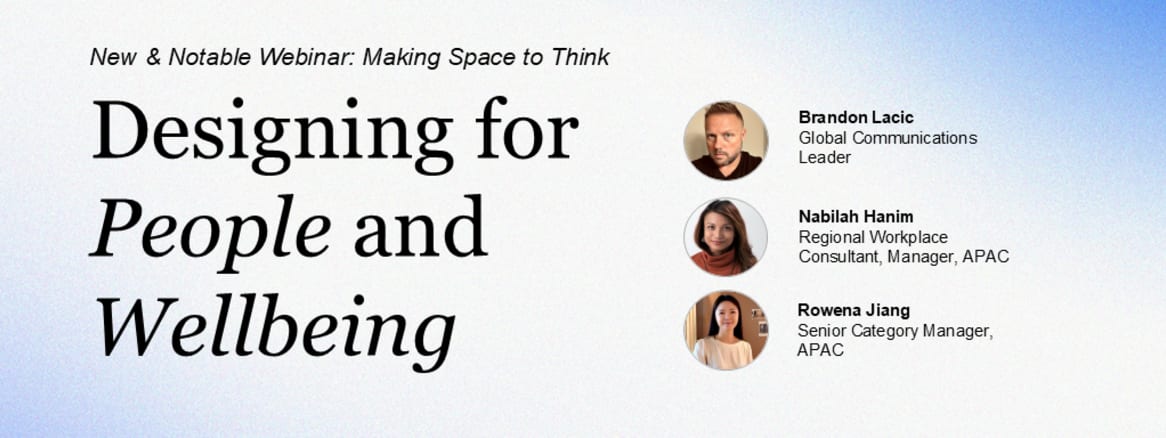
Join us for the Webinar
As organizations shift from operating in an Attendance Era to an Attention Era, the true measure of productivity is no longer the time spent, but the ability to think, focus, and create meaningful work.
Yet, many workplaces are still designed for visibility and efficiency, rather than how people actually work in the office. This gap shows up in familiar workplace challenges like persistent distraction, limited privacy and environments that don’t adapt to the different modes of work. When people are forced to do everything in the same setting, attention is fragmented and energy is depleted over time.
- Different work modes require different kinds of privacy. Deep focus, collaboration, learning and restoration require varying levels of visual, acoustic and territorial privacy.
- Distraction and lack of privacy are key barriers to focus. When environments offer limited control over noise and visual stimuli, people struggle to sustain attention and work effectively.
- Wellbeing and performance are interconnected.Spaces that support privacy, choice and moments of mental recovery allow individuals to perform their best over time.
These insights present a critical opportunity to reimagine the workplace as a system of spaces that better support focus, privacy, and adaptability in an increasingly demanding work environment. Drawing on Steelcase research and the five essential spaces, Amber Matthews, Global Director of WorkSpace Futures & New Business Innovation, and Meg Bennett, Global Design Principal, will explore how leveraging variety as a design strategy can help organizations respond to common workplace challenges.
Date: 29 April 2026
Session 1: 9am SGT / 11am AEST
Session 2: 4.30pm AEST / 7pm SGT
About the Speakers

Meg Bennett is a Global Design Principal at Steelcase, where she leads the translation of research and insights into spatial strategies that shape the future of work. An interior designer with two decades of experience in commercial architecture, interior design, and contract furniture, Meg specializes in using human‑centered design to create environments that elevate how people and teams perform.
Her work focuses on emerging work patterns and advancing inclusive design practices that ensure environments are supportive for all—promoting adaptability, belonging, and a broader spectrum of human needs. Meg is known for her ability to connect insights, design strategy, and business outcomes to reimagine what workplace environments can make possible.
A passionate advocate for design as a catalyst for change, Meg brings a forward‑looking perspective on how space can empower people, strengthen culture, and unlock new ways of working.

Amber Matthews is Global Director of the WorkSpace Futures & New Business Innovation teams at Steelcase, the leading provider of global workplace solutions. Based in Hong Kong, she leads a talented multidisciplinary research team across the globe in employing a human-centered, future-focused approach towards understanding the world of work in corporate, education and healthcare environments. In order to develop a deep understanding of user and organisational needs, Amber and her team of social scientists and business strategists use the practice areas and methods of strategic foresight, ethnography, UX research, technology concept explorations, data and market intelligence to generate insights, which are then translated into strategies, products, services and experiences.
Before joining Steelcase, Amber was a Service Design Lead at a strategic design consultancy, where she worked with organisations to build innovation systems, cultures and capabilities, through user research, market research, data synthesis and customer-journey mapping. Prior to that, Amber co-owned a boutique software development agency, amassing over 15 years’ experience in addressing digital transformation challenges across multiple sectors and geographies.

